an artist’s publication · a fictional poetry shop
Poetry
Voucher.
A poem, issued on receipt paper.
Existing poems, offered by the piece. Choose a version and complete a fictional purchase to obtain one continuous receipt-and-poem edition. The prices are real calculations; no money changes hands.
On paper
The receipt ends. The poem continues.
Two printed editions, B3 and B4. The transaction and the poem share one strip; a cut line offers a place to separate them.
Thermal paper · 26 September 2026
Original Chinese · website typefaces
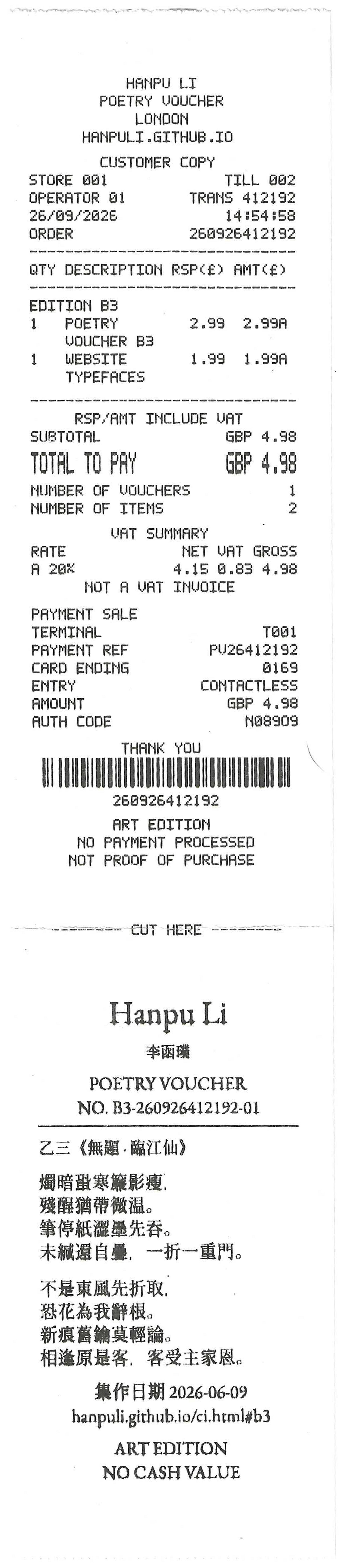
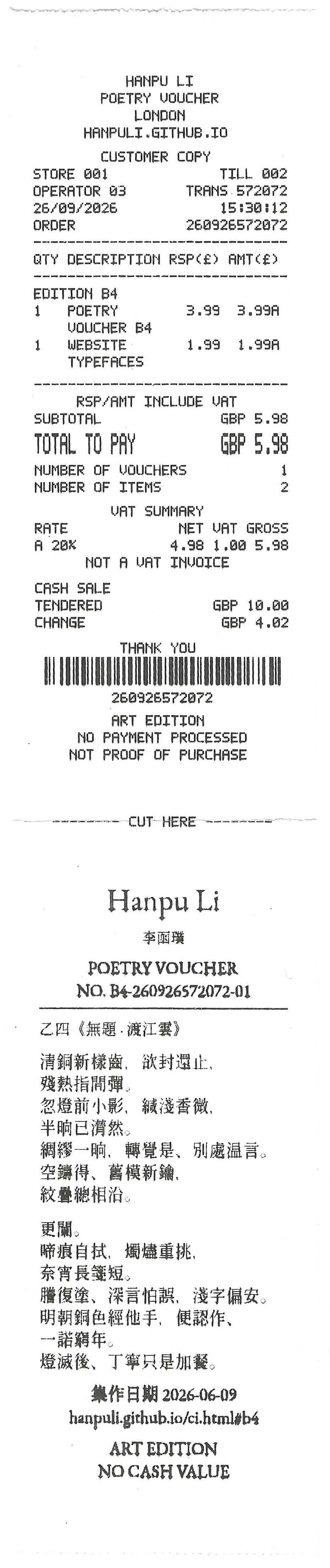
Scans of the actual prints. Straightened and cropped; the printed marks are preserved.
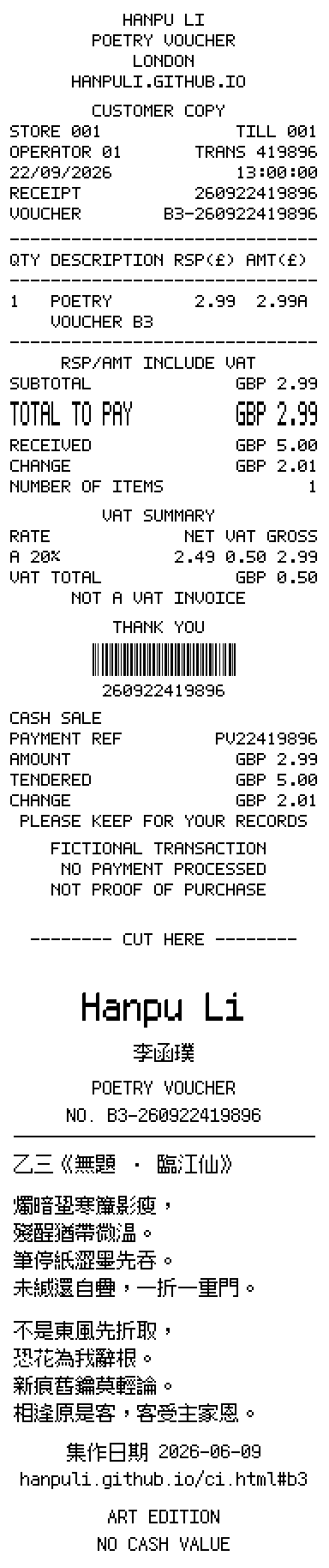
One order, one strip
The receipt comes first. A cut line offers a separation; it does not require one. Each poem copy carries its own order-linked number. The small image is a documentary specimen, not an actual-size reading proof.
B3 · original · pixel type · fixed scene dated 22 Sep 2026 · continuous digital re-render, 24 Sep 2026. Not a photograph or a live order preview.
Open the complete digital specimenAn edition, taken apart
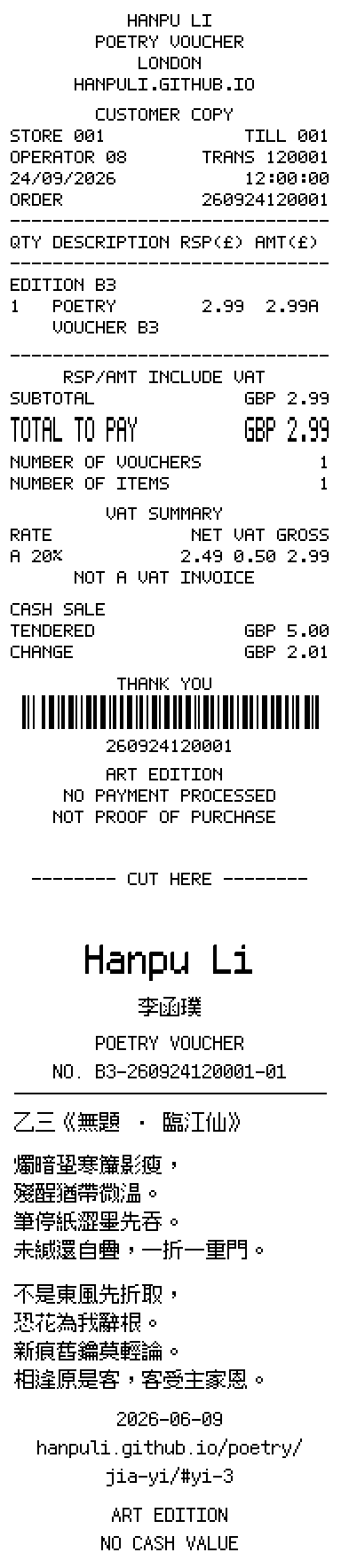
A new B3 specimen made by the current shop renderer: one copy, Traditional Chinese, base pixel type at 24 dots, no translation, simulated cash payment. The annotation follows the actual output from receipt to poem. The older specimen above remains a separately dated scene.
01 / Read along the strip
The strip below joins the shop’s receipt, CUT HERE segment and poem image in their output order. Widths retain the same scale throughout. Numbered leaders identify actual printed fields; this is a digital specimen, not a photograph of thermal paper.
- 01
Issuer and scene
The centred masthead gives way to store, till, operator, date and order fields. The order reference belongs to the transaction as a whole.
- 02
Item columns
Quantity and description start at fixed character positions; unit price and amount align to the right. A long description continues on the following line.
- 03
Total and payment
The total doubles the vertical dot scale while retaining the same character advance. The cash scene records tender and change.
- 04
Record and limitation
The barcode and reference identify this generated scene. The following wording states that no payment was processed and the strip is not proof of purchase.
- 05
Optional separation
CUT HERE occupies its own segment between the receipt and the poem. One order can continue with more numbered poem copies.
- 06
Poem and identity
Author, title, poem, source and copy number form a separate reading document. Its identifier extends the order reference; its text does not repeat the price.
02 / Paper, image, text
Three nested widths govern this output. The outer width is the PDF paper model; the central width is the raster image; the text has its own insets. The PDF centres the image with 5 mm on each side. A physical printer still needs calibration.
PDF paper width
58 mm / 464 dots
Image area
48 mm / 384 dots
Till line · 30 cells
45 mm / 360 dots
Poem text measure
44 mm / 352 dots
Dimensions in millimetres are derived at 8 dots/mm. Screen size varies with zoom and device; this drawing is proportional, not an on-screen ruler.
03 / A receipt is a fixed grid
This is the actual item-header crop. Four fields occupy 3, 11, 6 and 6 character cells, with one-cell separators and a final trailing cell. Every cell advances 12 dots. The receipt’s letters come from the renderer’s own bitmap patterns.
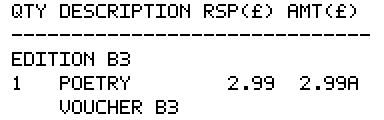
- 01 / Quantity
- 3 × 12 = 36 dots
- 02 / Description
- 11 × 12 = 132 dots
- 03 / Unit price
- 6 × 12 = 72 dots
- 04 / Amount
- 6 × 12 = 72 dots
The actual A pattern: 5 × 7 source cells. Each filled cell becomes 2 × 2 output dots; the advance is 12 dots and the normal line step is 24. For the total, the filled cells become 2 × 4 dots and the line step becomes 48.

04 / One poem, two type settings
The same first lines of B3, at a 24-dot body setting and the same 352-dot text measure. These crops come from two real shop configurations with no translations. The website-typeface option changes the charge; it does not change the poem.
Base · Fusion Pixel

Upgrade · website typefaces
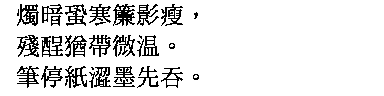
The base uses Fusion Pixel Zh HK on its 12-dot grid, with 32-dot line steps here. The website setting uses the project’s CJK serif stack with 31-dot line steps here. Both crops are one-bit output; the different silhouettes and spacing are visible in the pixels.
Open an image for its original pixels. Enlargements preserve hard pixel edges. These specimens document digital output; paper texture, heat spread and fading are not simulated.
Open the source page01
A poem on the shelf
The printer came first.
The project began after I found a receipt printer and tried printing my own poems on it. The poems already existed. The question came from the everyday familiarity of a supermarket receipt: what would it feel like to acquire a piece of personal writing through a process meant to handle goods by the unit?
Writing can hold an uneven investment of time, attention, knowledge and attachment. The shop offers a different description: a title in a catalogue, a quantity, a base specification and a price. This is not a division between pure poetry and thoughtless commodities. Ordinary goods also contain labour and differences that their prices do not disclose. The work isolates one act of reduction rather than claiming an entire theory of markets.
The public catalogue is deliberately limited to my published texts. An earlier open-text Studio has been withdrawn. Choosing how a particular poem is issued is the invitation; composing an arbitrary printout is a different activity. This editorial boundary leaves the reader’s interpretation, and what happens to the copy afterwards, open.
02
What a price leaves out
PV3 counts the source, not the effort.
Espeland and Stevens describe commensuration as comparison through a common metric. [1] PV3 supplies a small, inspectable instance: unlike poems become comparable sums by counting selected textual features. The formula is explicit about what it can see. It has no term for difficulty, revision, attachment or literary force.
Only Unicode letters and numbers count as characters. Non-empty source lines and stanzas add to the base amount; automatic wrapping on the narrow paper does not. The base is raised to the lowest .99 price not below that amount. Extras are added afterwards, so the final total need not end in .99.
The Roof Splits Open costs £12.99 in its first draft and £9.99 in its second. The source changes from 380 to 225 counted characters while its lines and stanzas stay constant. Deletion becomes a price reduction, regardless of what it does to the poem. That discrepancy invites comparison; it does not prove that the cheaper draft is better.
The steps also hide differences and exaggerate thresholds. A non-literary test of forty x characters is £1.99 as one line and £2.99 as two. Other added breaks leave the displayed price unchanged. This is a chosen retail convention, not a fair measure of length across writing systems or a model of how all shops price their goods.
The exact tariff · PV3
- Base
- £1.00
- Letter / number
- +£0.02
- Non-empty source line
- +£0.05
- Stanza
- +£0.10
- Base price
- Lowest .99 price not below the weighted base
- Website type
- +£1.99
- Added translation
- +£1.99
Per copy, for a non-empty original. Letters and numbers are counted after NFC normalisation. Punctuation and spaces are excluded from the character count; a non-empty punctuation-only line still counts as a line and can form a stanza.
03
The upgrade
Presentation is part of the offer.
Pixel type is the included edition. The website typefaces are an optional upgrade, like a product whose advertised appearance depends on an extra configuration. The basic edition must still be complete and readable. Deliberately degrading it would replace the question with a rigged demonstration.
The storefront is not outside this arrangement. Its serif display type, space and alignment make the offer attractive while it sells typography as an extra. The project both uses and exposes that appeal. An austere receipt does not make its surrounding website innocent of the prestige that design can confer.
A translation adds another linguistic and cultural reading, and a physical print would occupy more paper. Its fixed surcharge does not calculate paper length, energy or a translator’s working time. The poems and published translations can be read freely on the site; the extra belongs to the fictional output configuration, not an entrance fee to understanding. Traditional and Simplified Chinese are alternative scripts of the original at the same base price.
04
One strip, two documents
A transaction can end before reading does.
The receipt records the order, its quantities, extras, amounts and simulated payment. The poem voucher carries the text, byline, source and identifying number, without repeating its price. These are two kinds of document on one continuous strip, not necessarily two pieces of paper: one order may contain several separately numbered poem copies.
CUT HERE makes separation available after receipt and poem have been encountered together. Someone can keep the whole strip, cut it, fold it or pass on a part. None is a correct response that the interface should enforce. Numbering keeps the parts attributable; it does not authenticate a purchase, establish ownership or make a copy scarce.
The till’s British wording, columns, tax analysis and payment details supply a familiar administrative rhythm. The fictional notices are integral to that form, not small print to remove in pursuit of realism. No payment is processed. Here the voucher delivers a poem; it is not a promise of later cash redemption.
05
The poems do not explain the machine
A possible reading is not an origin story.
B3 repeatedly delays an act of delivery: the writing stops, the unsealed paper is folded again, and host and guest do not become equal parties in a settled exchange. Read after a receipt, those actions may make the certainty of a completed transaction feel inadequate. This is a reading the juxtaposition permits. The poem was not written to demonstrate it, and a reader need not adopt it.
Other relations belong to the source publications: B6 responds across the A/B sequence, while The Roof Splits Open retains its dated drafts. Issuing one poem should not force someone to acquire a whole sequence, but neither should a standalone copy pretend that no sequence exists. Source links allow a return to that context.
Drucker’s account shifts materiality towards what occurs in use. [2] For this work, choosing, waiting, reading, cutting and giving are therefore questions to observe, not effects guaranteed by paper or code. A pocketable poem can be a gift, a joke, a keepsake or waste. The receipt does not need every one of its fields to encode a separate metaphor.
06
Paper and screen
The same rule does not make the same encounter.
The output model uses narrow thermal paper. The one-bit image retains the constraints of receipt printing. Dense labels and narrow lines are part of the encounter, but smallness is not a virtue if the poem becomes unreadable. A sharp digital image does not establish the survival of fine strokes on a particular printer.
Direct thermal printing uses no ink or ribbon; heat, light and handling can change its legibility. [3] Fading is not a reliable countdown built into the poem. It remains a material possibility, not an observed life span of these particular prints, an environmental claim or a required metaphor for loss.
Early physical prints exist. The browser shop is the present public route while no exhibition venue is available; a future issuing table would add the handling and shared time that a download does not provide. The screen encounter is nevertheless real. The PDF keeps receipt and poems in one file, with continuations for long outputs. A self-contained HTML counterpart preserves their full text and relationship for offline reading; it does not turn the image PDF into an accessible text PDF.
07
Implementation
The mechanism is inspectable.
Poetry Voucher is a static browser application built around a fixed catalogue of my published poems. The former public Studio is retired: a reader configures an edition rather than supplying arbitrary text. Catalogue choice, script, published translations, typeface, size and quantity enter the same pricing and issuing process. Ordinary use does not upload the poem or contact a payment service.
Checkout freezes the contents of the order before output is produced: texts, quantities, charges, the fictional payment scene and the public renderer identity belong to that issued order. Reopening it later does not silently reprice the poems from the current catalogue. If a different renderer is used, the result is identified as a re-render. The renderer identifier describes build inputs, not a promise of identical pixels.
The frozen order is rendered into the narrow-paper image PDF and a separate self-contained HTML reading copy. The public website has no remote printer endpoint. On the paired H10S terminal only, an explicit print action can hand the already prepared order to its local print service.
- 01Catalogueauthored poems
- 02Configurescript · translations · type · size · quantity
- 03Freezetext · prices · payment scene · order identity
- 04Rendercontinuous receipt + vouchers
- 05Read / keepimage PDF · offline HTML
- 06Printpaired local H10S only
08
Two useful comparisons
Different rules, different consequences.
Short Édition offers free scroll literature selected by reading duration. [4] The comparison separates a distribution medium from a work’s specific mechanism. Poetry Voucher asks for a poem and a configured edition, then assigns a fictional amount. Its claim depends on what that purchasing routine adds to reading, not on being the first to print literature on a narrow roll.
In Broodthaers’s Pense-Bête, plaster obstructs access to the embedded books; readable copies were also exhibited nearby. [5] Here the relation is reversed: the printed text is intended to leave its apparatus. Yet the risk is shared. An intriguing object can draw attention away from the writing. Making the receipt more convincing is not automatically an improvement if nobody reaches the poem.
09
What is established
A working edition; an open question of reception.
The catalogue, pricing and digital issuing process can be used now. The early prints are material trials, not evidence that every current configuration is calibrated. The suggestion of carrying a poem to give away came from an early reader and was reported in the author interview. It has not been turned into a claim about audiences in general. No comparative reader study or gallery presentation is claimed here.
The next material test is modest: issue a few chosen editions, let people read and handle them without a preliminary theory lesson, and record what changes or fails. That may justify a decision to retain the receipt, alter an order of presentation or relinquish a proposed interpretation. More features cannot answer that question.
Personal saving, printing and giving printed copies are permitted. The author wrote and built most of this work; AI was used to review the website’s interaction logic and visual presentation, with final decisions made by the author. The shop selects existing poems and generates no poem text.
References and comparisons
These sources clarify particular questions of measurement, reading and material form. They are not a retrospective account of the project’s origin.
- Wendy Nelson Espeland and Mitchell L. Stevens. Commensuration as a Social Process. Annual Review of Sociology 24 (1998), 313–343; DOI 10.1146/annurev.soc.24.1.313. Definition in the publisher’s abstract..
- Johanna Drucker. Performative Materiality and Theoretical Approaches to Interface. Digital Humanities Quarterly 7(1), 2013, especially paragraphs 8–12. PDF · USC Scalar
- Zebra Technologies. What Is the Difference Between Direct Thermal and Thermal Transfer Printing?. Technical FAQ, direct-thermal sections; consulted 24 September 2026.
- Short Édition. The Short Story Dispenser. Publisher’s description of duration selection and free scroll output; consulted 24 September 2026.
- The Museum of Modern Art; Francesca Wilmott and Marcel Broodthaers. Pense-Bête (Memory aid), 1964. Marcel Broodthaers: A Retrospective, audio-guide transcript, item 13/16.
58 mm / 384 dots / 1 bit